Tuesday, 18 August 2015

Marshmallow, the official name of Android M

Android M is now officially Android 6.0 Marshmallow. If any of you managed to guess the right name, feel free to give yourself a pat on the back.

Google made it official via a blog post on the Official Android Developers Blog as well as by placing its mascot holding a marshmallow in front of the Android headquarters at Mountain View, California. In addition to this, the tweet from Dave Burke, VP of Engineering (Android), Google, also confirms the same

Android M was first unveiled by Google at the Google I/O event earlier this year, and is expected to make its way to devices by the end of the year. Although Android M is quite similar to Android Lollipop in terms of appearance, the focus is more on things under the hood by working on things like RAM optimization, battery optimization, advanced privacy settings, etc.

The other interesting features that will come with Android Marshmallow are native support for fingerprint scanning, app permissions manager, USB Type-C connector support, Google Now on tap, etc. The app permissions manager is a really good feature as it will give you the choice to allow/disallow any specific permission(s) from the list of all the permissions asked by app. You can make and change your choices any time even after installing the app.

Besides announcing the name, Google also announced the release of the official Android 6.0 SDK and final M Preview. It means that, developers can use Android’s latest API, API level 23, in their Android apps and publish them on the Play Store. The final M preview is available for Nexus 5, 6, 9, and the Nexus Player. If you want to try it out, then you can do so by waiting for an OTA update or by downloading the device system images.


Google announces standalone website for Hangouts

Jordanna Chord, a software engineer at Google, has announced on her Google+ page that Google has given Hangouts its own personal domain name on the internet. She added, "From our new site you'll be able to take advantage of the best of Hangouts in the browser, along with an inspiring image to get you through the day." 


Earlier, there were three ways to access Hangouts, though Gmail, Google+, or though brower plugins. While methods are still available, the aim of the new website is to makes things much more straight forward. Users simply need to sign-in to their Google account and visit the Hangouts website. It will welcome you and will show three quick options to initiate video call, audio call, or chat.


From the sidebar on the left, users can easily switch among contacts, conversations, and phone calls. The rest of the options can be accessed by clicking on the 'three dot' icon present just below the phone calls option. It will give you access to settings and links to the Hangouts app download page. The Hangouts website also shows new images in the background that keep changing over time. 


Recently, Google also released an update for Hangouts app on Android and they have already made Hangouts the sole messaging app after shutting down GTalk earlier this year.  Other than this, Google has also announced Marshmallow as the official name of Android M along with the release of Android API level 23 and final M preview for users to try out.


Lenovo and Moto will 'Make in India' too

Lenovo announced today that it will make smartphones for its own brand and for Motorola Mobility in India, out of its manufacturing plant in Sriperumbudur, Chennai. Moto E units are already rolling out of the Chennai plant, while Lenovo has stated that its K3 Note will follow soon. The plant presently has a 6 million units manufacturing capacity, with Lenovo projecting a target of 14 million units manufacturing capacity for the next fiscal year.

The plant will house separate manufacturing lines for Motorola and Lenovo devices, and will have 1,500 employees for manufacturing, testing and assembly lines. The companies have stated “huge success” in India as the reason to decide on manufacturing in the country. Previously, Lenovo had PC manufacturing plants in the country, and hopes to see similar success with its cellphones too. 

Chen Xudong, President MBG group and Chairman of Motorola Mobility Operating Board, stated via the official press release, “Lenovo is not new to manufacturing in India. We recognised the potential of India and invested in PC manufacturing several years ago. 

We are excited to expand our presence, and tap into India’s competent talent pool that will enable us to develop cutting-edge products for our customers across the world.” Alongside manufacturing, supply chain operation and back-end services integration are also under way. Amar Babu, Chairman of Lenovo India and COO of Lenovo Asia-Pacific, stated that manufacturing locally in India will not result in online-only cellphones like the Lenovo K3 Note to be brought to offline retail stores. Distribution strategies are presently being discussed, but as of now, the cellphones will be sold and distributed using the existing system only.

Wednesday, 29 July 2015

Motorola launches 3rd gen Moto G: SD410, water resistance

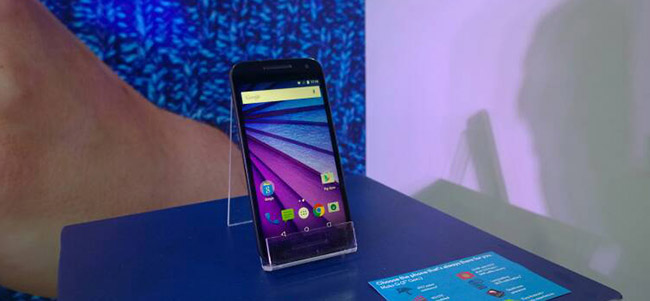
Motorola has announced the 3rd generation of its mid-range smartphone, Moto G. Moto G 3rd generation features 3 feet of water resistance for a continued duration of 30 minutes, along with a quad-core Snapdragon 410 processor, 13-megapixel Sony IMX214 CMOS sensor with multi-layer IR filter (same as the Nexus 6), 5-megapixel front camera, and runs Android v5.1.1.


Moto G 3rd generation will have two models. The cheaper one, at Rs. 11,999, will have 1GB of RAM and 8GB of internal storage, while the more expensive one at Rs. 13,999 will have 2GB of RAM and 16GB internal storage. Both the variants will be fit with an expandable memory slot. To promote sales,Motorola India’s General Manager Amit Boni has stated that existing Moto G users can exchange their old phones for the 3rd generation Moto G and avail a hefty discount. Additionally, new buyers will get a host of offers and discounts until August 2, including Myntra and Flipkart gift vouchers, 100 percent cashbacks, 100 Moto 360 smartwatches at Re. 1 and bundled deals with service provider Airtel that include free data and Wynk subscription.


Motorola was expected to launch the 3rd generation smartphone today, after sending invites about a week ago. The 3rd generation Moto X, which has also been rumoured and leaked quite often lately, was also touted for a launch, but it was not unveiled today. The 3rd generation Moto G, with a 5” HD display, will primarily rival the Rs. 12,999-priced Asus Zenfone 2 (2GB RAM, 16GB storage), Xiaomi Mi 4i 16GB, and the lower-priced Lenovo K3 Note and Yu Yureka Plus. Moto G will be sold exclusively via Flipkart, and will be available online from tonight, 12am onwards.
Here's what Motorola has enlisted in the Press Release about what's new in the 3rd generation Moto G:

Advanced water resistance
Water is your phone’s worst enemy. IPX7-rated protection keeps your Moto G (3rd Gen) safe from splashes and accidental drops in water. Designed to withstand immersion in up to 3 feet of fresh water for up to 30 minutes, provided the back cover is properly sealed. Not designed to work while submerged underwater. Do not use while swimming, or subject it to pressurised streams of water.


Stronger battery
Go all day without plugging in thanks to a long-lasting 2470 mAh battery. Think about everything you want to do, not how much time you have to do it*


Qualcomm® Snapdragon™ 410 processor with quad-core CPU and 4G LTE
We have upgraded Moto G (3rd Gen) to the Qualcomm® Snapdragon™ 410 processor with a 1.4 GHz quad-core CPU. The Moto G (3rd Gen)  will have 4G LTE network speed capability which means users have faster internet, streaming, gaming and instant connectivity.


Android™ OS, Lollipop
The Moto G is powered by Android™ 5.1, Lollipop, the latest released version of the world’s most popular mobile OS and delivers a pure Android experience. That means we don’t hide the operating system under custom skins that get in the way and take up valuable resources. It also means your Moto G (3rd Gen) is a beautiful, intuitive, and fast performing device. The phone doesn't slow down or eat up your storage space as the device brings a pure Android experience.


Camera
13 MP rear camera: The
 best camera ever available on a Moto G (3rd Gen) yet. Featuring a 13 MP imaging sensor, f2.0 lens, and Hybrid Multilayer IR cut filter, you can truly capture the best looking images in any lighting condition. And when ambient lighting isn't enough, the new Dual Dynamic Correlated Colour Temperature (CCT) flash automatically adjusts to ensure you get natural looking skin tones and consistent vibrant colours.


5 MP front camera: You’ll look great whether you’re taking a selfie or chatting on a video call. The front camera offers a wide 72 degree field of view, and features Motorola’s “Best Shot” feature which captures multiple shots before and after you touch the screen, recognising issues like blurred subjects or blinking eyes and recommends the best picture to keep, so you always get the best shot. In darker conditions, the phone’s display will even flash to add a little extra light to your shot.


Quick Capture
Instantly launch the camera by twisting your wrist twice. Twist twice again and switch to the front camera.

Chop twice for flashlight

Flick your wrist twice quickly to launch the flashlight and repeat to turn it off. No need to unlock your phone or take off your gloves to get the light that you need.

Moto Display

Moto Display gives you a simple, discrete preview of notifications and updates, so you don’t have to wake your phone to see what’s going on.

Updated design

The back of the Moto G (3rd Gen) now features an updated design with a new metallic accent around the camera and a new texture for additional grip, plus the same great curved design for easy one-handed use.

5-inch HD display

Bring videos, pictures, and everything else to life on this brilliant, scratch-resistant HD display that spans edge to edge. With 294 pixels per inch, it’s incredibly sharp, so text and images always appear crisp and clear. And it’s protected with Corning Gorilla Glass 3, an extra-evolved glass that’s designed to be tough and take scratches and scrapes. 

Free upgrade across 190 nations - Windows 10 launched

The much-spoken-about OS. Windows 10, is finally here, presently rolling out as a free upgrade for users across 190 nations. Windows 10, the much-hyped successor to Windows 8, is here, and is presently being given out to existing Windows users across 190 nations. Launch events are being held in 13 cities, including New Delhi. The new operating system has undergone eight months of development, right from adding new features to innumerable patches and fixes. Microsoft’s Windows Insider program, that gave rolling updates to Windows testers, has already given an extensive preview into what can be expected out of Windows 10, and here is officially what’s new.

Microsoft is touting Windows 10 to be the “most secure” Windows ever, with new features as the Edge browser, Cortana, Photos, Xbox app and a number of new features. Windows 10 has also been said to be the ’final’ version of Windows, and Microsoft will be providing rolling updates to keep the operating system up-to-date with future standards. Additionally, Windows 10 is not being looked at as a standalone PC operating system, but as a universal platform for multiple devices of varying form factor, echoing CEO Satya Nadella’s objective of providing a universal platform for all devices. Windows 10 also features Continuum, which will allow future Windows 10 Mobile devices to convert into the PC form factor when connected to a larger display and a keyboard bundle.
Windows 10 is more personal and productive, with voice, pen and gesture inputs for natural interaction with PCs. It’s designed to work with Office and Skype and allows you to switch between apps and stay organized with Snap and Task View. Windows 10 offers many innovative experiences and devices, including the following:


  • Cortana, the personal digital assistant, makes it easy to find the right information at the right time.
  • New Microsoft Edge browser lets people quickly browse, read, and mark up and share the Web.
  • The integrated Xbox app delivers the Xbox experience to Windows 10, bringing together friends, games and accomplishments across Xbox One and Windows 10 devices.
  • Continuum optimizes apps and experiences beautifully across touch and desktop modes.
  • Built-in apps including Photos; Maps; Microsoft’s new music app, Groove; and Movies & TV offer entertainment and productivity options. With OneDrive, files can be easily shared and kept up-to-date across all devices.
  • A Microsoft Phone Companion app enables iPhones, Android or Windows phones to work seamlessly with Windows 10 devices.
  • The all new Office Mobile apps for Windows 10 tablets are available today in the Windows Store4. Built for work on-the-go, the Word, Excel and PowerPoint apps offer a consistent, touch-first experience for small tablets. And for all your digital note taking needs, the full featured OneNote app comes pre-installed with Windows 10. The upcoming release of the Office desktop apps (Office 2016) will offer our richest feature set for professional content creation. Designed for the precision of a keyboard and mouse, these apps will be optimized for large screen PCs, laptops, and 2-in-1 devices like the Surface Pro.

Tuesday, 2 June 2015

Full number portability to be available by July: Ravi Shankar Prasad

IT Minister Ravi Shankar Prasad has announced full Mobile Number Portability (MNP) will be available from July this year. The minister further announced state-run telecom operator BSNL will start offering free roaming services to its users in the country starting June 15. The telecom operator will also be making Wi-Fi hotspots operational in major tourist spots in the coming two years.Pan-India mobile number portability has been one of the important points of the National Telecom Policy 2012. However, roll-out of the service had seen several delays.

The earlier deadline to roll out full MNP was May 3, but a recent report said the government had extended the deadline as telecom operators hadn't completed testing necessary software. The latest set of announcements come shortly after the government allowed customers dial STD mobile numbers without adding 0 or +91 – move that was considered a major step towards implementation of the full MNP in India. Operators such as Vodafone and MTS have already rolled out the feature.
"The dropping of 0 and +91 was in order to facilitate timely implementation of nationwide MNP. Without this, it would have taken nine months or so to implement MNP. Now, a small number of customers may have to pay STD charges if not aware of it. However, as the price differential between local and STD charges are not great, customers may find this a small price to pay to enjoy national MNP,” Rajan S Mathews, director general of the Cellular Operators Association of India (COAI) had said. "Otherwise if some companies do not have the technology in place, subscribers of other companies would not be able to reach them."As far as BSNL goes, the operator has been making efforts to sustain the competition. Recently, the operator launched a carry forward scheme that allowed its subscribers to use unused data after the new recharge.
For the landline segment, the operator had announced unlimited free calling scheme from its fixed line phones to any operator including mobiles from May 1 in order to boost its landline business. BSNL has also announced slashing 3G tariffs by 50 percent as part of its 8th phase of network expansion.

Windows 10 to release on July 29, confirms Microsoft

Microsoft has announced the release of its Windows 10 OS from July 29th. The software maker has started prompting users with Windows 8, Windows 8.1 and Windows Phone 8.1 to reserve their free upgrade to Windows 10 OS.Many users have started getting the “Get Windows 10″ prompt on their devices. Redditt user p4block reported the message for his Windows 8 computer and after that other users have also confirmed receiving the message for their Windows 7 and Windows 8 devices as well. Windows 10 brings back the Start Menu from Windows 7.

Microsoft has preloaded Windows 10 OS with Voice assistance Cortana Integration, a new browser- Microsoft Edge and Windows Defender anti malware protection. Apart from this Windows 10 also brings new photos, music, maps, mail, calendar and more apps to users.

Microsoft states in a press release," From the return of the Start Menu to the variety of innovative features, Microsoft created a more personal, fun and productive Windows experience".
Microsoft explains the “How this free upgrade works”:
1. Users have to reserve their FREE upgrade to Windows 10 now. It will download once available, and users can cancel their reservation at any time.
2. Users will get a notification after Windows 10 is downloaded to their device. They can choose to install the upgrade right away or choose a time according to their convenience.
3. After the install, Windows 10 can use it right away.

The asterisk at the bottom explains that the free upgrade is a full version of Windows 10 and requires 3GB for the download. The prompt also stated that the free upgrade will be available for a limited time period for a year and after that users will have to pay for the Windows 10 OS update. Earlier today Window 10 pricing and release date were accidently leaked by online retailer Newegg.com. The listing reveals that the Windows 10 OEM copies will be released on August 31. The Professional version will be priced at $149 and the Home edition will cost $109. In 2012 Newegg.com had also started taking pre-orders of Windows 8 before its official launch. Microsoft is planning to launch the OS for all devices ranging from low cost smartphones to desktops. In a report the company had stated that it plans to make the Windows 10 OS available for a billion devices in the next two to three years.


BMW launches the new 6-series Gran Coupe starting at Rs. 1.15 Crore

The new BMW 6-series Gran Coupe is now available at every BMW dealership across India  as CBU or Completely Built-Up unit. All India ex-showroom prices of the new BMW 6 Series Gran Coupe are:
BMW 640d Eminence: Rs.1,14,90,000
BMW 640d Design Pure Experience: Rs.1,21,90,000

BMW, the German car manufacturer known for its luxury o

fferings introduced the new BMW 6-Series Gran Coupé facelift here in India at a starting price of a whopping 1.15 crore. And what better platform to launch a uber luxury car such as this one than at the curtain raiser event or preview of the upcoming BMW India Bridal Fashion Week 2015? The event kicked off with a small fashion show where they showcased models flaunting bridal designs by various top designers from the country which then culminated into the big reveal of this new 6-series beamer. Bollywood actress, Sonakshi Sinha who was the show stopper at the show unveiled the car as well.

BMW is aggressively hitting the market with quite a lot of new car launches every few months. This new 6-series Gran Coupé is a slight but noticeable upgrade to the previous model as BMW has made some visible changes to the exterior but it still retains the original 3.0-litre engine from its predecessor. As for options within the same model, the Gran Coupé will be available in two versions - the BMW 640d Eminence and the BMW 640d Design Pure Experience both of which are priced at Rs.1.15 and Rs.1.21 crore respectively.

Everything about the new 6-series 640d Gran Coupé under-the-hood remains the same as its previous version. It comes with a 6-cylinder 3.0-litre engine with an in-line diesel powertrain. Capable of accelerating and reaching 0-100 km/h in under 5.4 seconds and a limited top speed of 250 km/h, the engine can output a sweet total of 313bhp. High torque of 630 Nm is available at even a minimum of 1,500 and 2,500 RPM as well. The engine is mated to an 8-speed dual-clutch (Steptronic Sport) automatic transmission that features Cruise Control and lets you experience smooth gear shifts and improve driving dynamics.

The most prominent changes made to the new 640d Gran Coupé include design modifications to the front and rear bumpers, redesigned LED headlights and fog lights along with a chrome-plated tailpipe. Even the exterior mirrors have received a subtle design change and they now include light strips at the sides which can be used as side indicators.

Major differences between the 640d Eminence and the 640d Design Pure Experience are that since the latter is costlier, it comes with extended dual colour Nappa leather upholstery in Cognac/Black. Apart from that, you also get features like ambient lighting and a sports leather steering wheel in the interior of the car. The exterior of the 640d Design Pure Experience exudes class as it comes with 19-inch light alloy wheels, shadow line and dark chrome exhaust pipes, LED fog lights. Using the Driving Experience Control switch, the driver is able to choose between different driving modes to suit the driving conditions (ECO PRO, Comfort, Comfort+ and Sport). In addition, Dynamic Damper Control adapts the shock absorber characteristics and adjusts to suit both the road condition and driving style.

As with most new high-end BMW offerings, this 6-series Gran Coupé also comes with BMW EfficientDynamics that helps reduce fuel consumption and improve driving as a whole. This is because of intelligent lightweight construction, auto start-stop feature, ECO PRO mode, brake-energy regeneration, 50:50 weight distribution and more technologies. It doesn’t end there as it features BMW ConnectedDrive technology, which is why, the car provides a host of next-gen assist systems and services. The inclusion of BMW iDrive with that comes with a 10.2-inch colour display with 3D maps has touch controls. Other than that, full-colour heads-up display and connectivity via Bluetooth and USB is certainly good to have. Audio inside the car is taken care of by using a surround sound setup from Bang & Olufsen controllable through BMW apps. They make parking easy by providing Park Distance Control (PDC) at the front and rear ends of the car along with a rear view camera that comes installed by default.

At the occasion of launch, Mr. Philipp von Sahr, President, BMW Group India said, “At the heart of BMW is not only brilliant automotive engineering but also the desire to evoke emotions and spread joy. Our automobiles are not just the end of a creative process but a beginning. Likewise, an Indian wedding is a celebration of emotions, aesthetics, craftsmanship and opulence. BMW also celebrates these values that are cherished by our esteemed clientele. BMW India Bridal Fashion Week has established itself as a unique avenue where the best of Indian fashion designers open doors to the latest trends in ‘Bridal Couture’. It is the perfect platform for the launch of the new BMW 6 Series Gran Coupé which combines absolute luxury and immaculate design with adrenalin rushing performance.”


Google introduces a new Identity Platform for secure login

Google has announced a new Google Identity Platform that gives developers a suite of tools to secure apps. The new tool allows users to sign in to third party apps with their Google Login similar to the way they login into service like Gmail, Play, Google+, and other Google services.The platform has three flagship tools including Smart Lock for Passwords, Google Sign-in and Identity Toolkit. Smart Lock comes with an integrated password manager that allows users to sign in automatically to Android apps. The feature also supports auto fills credentials on websites viewed with Chrome. Smart Lock prefills login credentials across devices and prompts the app to save a password for future use.

The tools have been used by Google to secure its services internally for some time now and have extended the functionality to third-party apps and developers through APIs now.Google Sign-in allows users to securely connect to an app or site. The feature enables users to sign in with a Google account to log onto other third-party apps that integrate Google Sign-in. According to a report, New York Times claims that it has experienced a significant increase in new user sign-ups due to the new easier Google Sign-in. Google Identity Toolkit comes with a comprehensive authentication system which the company describes allows developers to "do sign-in the right way." The toolkit grows with apps and supports email and password authentication.

Nontechnical developers can utilize the toolkit with simple configuration changes that add future sign-in options and migrate existing users.Earlier today Google has also announced a 'My account' dashboard for users provides a 'step-by-step guide' through the users most important privacy and security settings. The new tool will give users more clarity on what information the internet giant can see from profiles and will also enable users to limit Google from logging their activities on PC's and mobile devices.

The internet giant has been working to boost the security of its Web and mobile apps and has started tweaking its search ranking algorithms to encourage more websites to use secure encrypted connections. Last year, the company announced encryption for all Gmail messages.

Friday, 22 May 2015

Users can now dial STD phone numbers without adding 0 or 91+ prefix under the full MNP initiative.

Mobile phone and landline users can now dial any STD number without using a prefix ‘0’ or +91, according to an order by the department of telecom (DoT) to leading telecom companies.The move is a part of the TRAI’s ruling of full mobile number portability (MNP). Many leading telecom service providers have started implementing the service while others are putting in place the requisite technology and carrying out trial runs. Vodafone India has implemented the order on its network across cities and also with subscribers of other companies like Bharat Sanchar Nigam Limited (BSNL). A MTS India spokesman also confirmed that the company has rolled out the facility across all its nine circles. "We had already carried out the trial runs earlier and our subscribers do not need to use the prefixes for making STD calls," he added.Rajan S Mathews, director general of the Cellular Operators Association of India (COAI), said, "The dropping of 0 and +91 was in order to facilitate timely implementation of nationwide MNP.

Without this, it would have taken nine months or so to implement MNP. Now, a small number of customers may have to pay STD charges if not aware of it. However, as the price differential between local and STD charges are not great, customers may find this asmall price to pay to enjoy national MNP." Mathews added that all telcos will have to complete the process for full MNP. "Otherwise if some companies do not have the technology in place, subscribers of other companies would not be able to reach them."Pan-India mobility was supposed to be implemented by May 3, but due to technical issues the deadline for it has been extended by another 2 months.

Telecom industry body COAI had asked for an extension in implementing nationwide MNP as telecom operators have to make some technical changes to their networks due to changes in national numbering plan (NNP). Pan India MNP will allow subscribers to move from one mobile network to any telecom circles in the country with the same mobile number without paying for roaming charges. As per the latest deadline full MNP will be implemented by July in India.

Cyanogen plans to invest $80 million in start-up acquisitions in India.

Open source mobile OS developer Cyanogen plans to open an office in India in the next three months. According to reports, the company plans to invest $80 million to acquire start-ups in the country. The company’s India team will be located either in Delhi or Bangalore and will have at least 50 employees, representing a third of its current employee base.Reportedly, Cyanogen plans to hire more people to add local flavors to its custom Android operating system in the form of some local apps and features. Quality testing and assurance in the country will also be done from the new base.

The company has raised over $110 million in funding till date of which $80 million came in just this march from Premji Invest, Twitter Ventures, Qualcomm and others. Cyanogen plans to invest a large part of the funding into acquiring smaller companies and teams in India. Vikram Natarajan, senior vice-president of global partnerships and distribution at Cyanogen stated, “India is very attractive. It is one of the hyper-growth markets for mobile today, … Premji Invest is a big investor…and that was a deliberate decision, as India a big market for us.” "What we strongly believe that global giants don't is that any country with a large population will have the rise of a local ecosystem. We're going to start seeing that in India," he added.CyanogenMod was an open source project that tinkered with the Android in 2009.

The company has now over 9,000 contributing members. The company’s founders "Kirt McMaster and Steve Kondik" made Cyanogen a commercial entity in 2013 headquartered in Palo Alto. According to research firm eMarketer, India is poised to overtake US as the fastest-growing smartphone market in 2016, making it very attractive to domestic as well as international companies.

Cyanogen already has a deal with Micromax to exclusively install its Cyanogen OS onto the company’s handsets. Natarajan added that the company will see how the expansion pans out and then it will decide whether to partner up with more local brands.

Major privacy and security issues found in UC Browser

Citizen Lab has found a number of major security and privacy issues in the English language and Chinese language editions of the Android version of UC Browser.A Canadian research group has found that popular mobile web browser, UC Browser, is putting privacy of its users on risk by leaking sensitive data. The group found that the browser had given third parties access to sensitive users information such as location, search details and even device numbers. Alibaba spokesman Bob Christie, however, has claimed that the issue has been fixed as well as users have been notified about the update. Alibaba Group Holding Ltd had acquired UCWeb in June 2014.

According to Citizen Lab, the Chinese and English version of UC Browser had leaking the sensitive data that "represents a privacy risk for users because it allows anyone with access to the data traffic to identify users and their devices, and collect their private search data". The research group pointed out that the Chinese version of the mobile web browser was more vulnerable and that “a significant number” of sensitive data including personal and location information were left exposed to third parties. "By leaking a large volume of fine-grained data points to multiple network operators, the UC Browser app is increasing the risks to its users that such data may be used against them by authorities, criminals, or other third parties," the group further pointed out. Check out the full Citizen Lab report here.

UC Browser is one of the most popular mobile web browsers. The browser is estimated to have 500 million registered users and is very popular in India and China. UCWeb last year had announced a Partner Program in India that helped app developers acquire users as well as monetize their offerings. The program, made available through UCWeb’s 9Game/9Apps operation, offered mobile developers a suite of supports from low-cost and efficient user acquisition, fruitful app/game monetization, preferential revenue share plan to funding for remarkable developers. In order to boost its ecosystem, the company has launched a public beta of UC Browser for PCs featuring Cloud Sync, smart file manager and more. The browser has been launched in two versions- an Indian version and a general version. Users can download the UC Browser for PC Beta from pc.ucweb.com.

Google reportedly working on 'Brillo OS' for IoTs

Google is working on a new software called ‘Brillo’ for low-powered devices that connect to the internet. Google's new lightweight version of Android OS will help smart devices connect easily with each other.The internet giant is expected to reveal more details about Brillo at the upcoming I/O developer’s conference. According to reports, Google’s Brillo software will be able to power devices with 64 or 32 MB of RAM.

The internet giant is likely to release the software under Android OS, as the group developing the software is linked to the company’s Android unit. The lower memory will enable devices running the new software would mark a sharp drop from the latest versions of Android, which is aimed at mobile phones with at least 512 MB of memory. Brillo software will also work with sensors and dongles that comprise connected life. Currently Brillo is aimed at smart connected devices and would make it easier for other companies to build everything from “smart” fridges and light bulbs to garden monitors. Google had acquired Nest, which has a ‘Works with Nest’ framework developers can tap into via a set of APIs. The software will be a priority for Google as the software could power all Smart devices. Apart from this Google is also expected to make some announcement around Android Wear, a new Android OS dubbed Android M and new voice commands to access Android devices.


Apart from Google, rival Huawei has announced LiteOS at an event in China that aims at providing the "infrastructure companies need to build out connectivity in their devices." Earlier this month, electronics giant Samsung has also introduced the Artik line of hardware, which is aimed at “unifying wearables and other smart devices” with open software and Samsung hardware. Research firm Gartner reposts that the number of networked devices will surge to 26 billion units by 2020 from 900 million in 2009. Many device manufacturers have been making big bets on the Internet of Things, the concept of using sensors and other technologies to hook just about anything you can think of into the Internet. Research firm IDC says that the IoT market will hit $3.04 trillion by 2020.

Tuesday, 31 March 2015

Gmail's latest update brings unified inbox

Gmail bring unified inbox, smart search, conversation view to IMAP/POP accounts and more with the latest Gmail app update.Google has finally brought the combined inbox feature, a long awaited feature, to its Gmail app. The feature is pretty simple and looks well executed as it combines all your linked email accounts to give you a combined inbox.

If you have IMAP or POP accounts (like Yahoo and Outlook) linked in your Gmail app, emails from those accounts will also show up in your combined inbox as well.

The latest update to Gmail brings conversation view to IMAP and POP accounts. This functionality was limited to your Gmail accounts till now.

So, now all your non-Gmail accounts will also show up as stacked conversations.Other new features include a better smart search for faster searches, more responsive animations, larger attachment previews and single tap save to drive functionality.

The update is now available and will be rolling out gradually. Users will be getting the new update in the coming weeks.


MediaTek unveils Helio series of SoCs for high-end smartphones

MediaTek has introduced a new series of chipsets called Helio. The new MediaTek processor is for the high end phones and is expected to compete with Samsung's Exynos and Qualcomm's Snapdragon 800 series.The first MediaTek Helio chipset will be a 'X10' series, featuring 64-bit support based on eight Cortex A53 cores and clocked at 2.2GHz. The SoC supports display refresh rates at 120MHz, and slo-mo videos at 480 fps. Another Helio P series is set to launch later this year. Smartphones running MediaTek's Helio chipsets are expected to be available by second quarter of this year.

MediaTek has a strong presence in the budget and mid-range segments, however the top end smartphone segment is dominated by Qualcomm. Samsung also puts its Exynos chipsets in its flagships. MediaTek is expected to tap the top end segment with its new Helio series.

Recently, reports had emerged that MediaTek was working on processors with 10 or 12 cores. A Chinese blog claimed that MediaTek is exploring 8-core CPU solutions and could venture their research into 10 and 12 core CPU territory.Earlier this year at the MWC 2015, the company unveiled new technology solutions. The new announcements included Crossmount, SoC 8173 ARM tablet and a multimode wireless charging chipset.

Snapdragon 808 powered LG G4 to be unveiled on April 28

LG has started sending out invites to the media for an event, to be held on April 28. The event is likely the launch of the company’s next flagship, LG G4. The smartphone, which was recently leaked on the XDA Developers Forum, has been expected for a while now. According to leaks and rumours, the device will come with a stylus, similar to Samsung’s S Pen and will feature a quad-HD display with a hexa-core 64-bit SoC.

LG’s invitation though doesn’t give much away. It simply says ‘See The Great, Feel The Great’. The event will be held simultaneously in New York, Paris, Singapore, London, Istanbul and Seoul.

The 64-bit hexa core SoC of the LG G4 is said to have four ARM Cortex A53 cores and two ARM Cortex A57 cores, along with the Adreno 418 GPU for gaming and other purposes. In case you’re wondering, this is the Snapdragon 808 processor from Qualcomm. LG seems to have reserved the Snapdragon 810 for its G Flex 2 and rumoured G Note smartphones, say reports.

LG had recently announced its new G Flex 2 smartphone along with the LG Watch Urbane smartwatch in India, at the LG Tech Show held in Delhi. The company also brought its 5K 105 inch television to the country at the same event. The LG G4 should also be announced in India by late April or early May.

Monday, 30 March 2015

South Korea maintains highest internet speed of 22.2 Mbps : Akamai

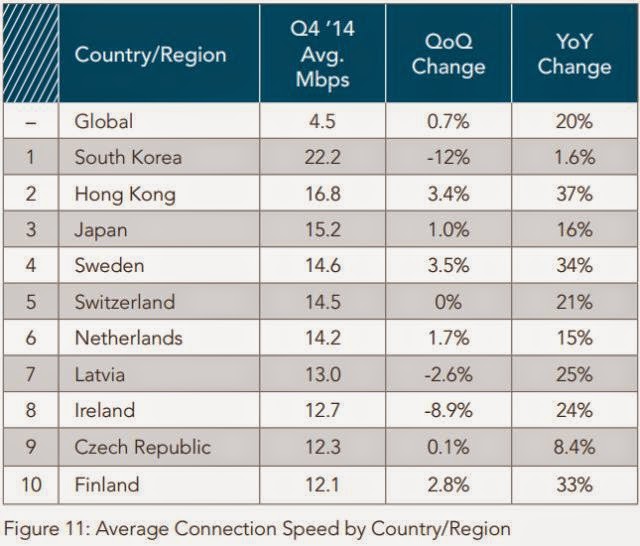
Cloud services provider Akamai has published its State of the Internet report, revealing the top 10 countries with highest Internet speeds.Broadband speeds around the world have gone up by 20 percent year-on-year, while mobile data traffic has grown by 54 percent in the last year, says a recent report by Akamai, an US-based cloud services provider.

Akamai has published its latest State of the Internet report, which reveals that over the last year average internet connection speeds increased in 132 countries. South Korea still boasts of the fastest connections in the world with an average speed of 22.2 Mbps. Hong Kong followed by Japan were in second and third place, with average internet speeds of 16.8Mbps and 15.2Mbps respectively. Sweden was fourth with Internet speeds of 14.6 Mbps followed by Switzerland with 14.5 Mbps speed.

Hong Kong peak connection speeds were even higher than South Korea at 87.7Mbps on average, followed by Singapore with 84Mbps peak speeds and South Korea at 75.4Mbps.Overall, the global average internet connection speed rose a nominal 0.7% quarter-over-quarter to 4.5 Mbps, says the report. India, which has reportedly overtaken US as the world's second biggest internet nation, recorded peak internet speed at 14.5 Mbps and the average connection speed was 2.0 Mbps, with a growth of 2.1% quarter-over-quarter and 28% year-on-year.

David Belson, editor of the report stated, "Over the course of 2014, we've seen healthy global growth across all of our key metrics for Internet connectivity, broadband adoption and 4K readiness. The positive trends make an interesting contrast to a recent study that found 4.4 billion people around the world do not go online, indicating a strong need for continued efforts to improve and de

Qualcomm Snapdragon 815 could be based on quad Cortex A72 and Cortex A53 cores

Fresh rumors about the next-gen Qualcomm Snapdragon 815 SoC point at big.LITTLE combination of quad Cortex A72 and Cortex A53 cores.The upcoming Snapdragon 815 will be similar to the Qualcomm Snapdragon 620 which is already launched, with quad-core Cortex A72 and A53 cores using the favorite big.LITTLE technique. According to reports, the processor will have the next generation Qualcomm Adreno GPU and will be manufactured using the new FinFet process.

Sources stated that Qualcomm may tweak the cores to boost performance and will have all the features that you can expect from a top-end Snapdragon 800 series chipset. Other rumored specifications of the 815 SoC indicate that it would include LDDR4 RAM and MDM9X55 LTE-A Cat.10 modem.Earlier details had emerged that the Qualcomm Snapdragon 810 chipset was overheating and a big customer had dropped the processor due to issues.

Qualcomm has reportedly solved the issue and had recent conducted a test internally that shows that the Snapdragon 815 runs cooler than both the Qualcomm 810 and Qualcomm 801 chipsets.Sources state that Qualcomm has delayed the launch of Snapdragon 815 mainly because the company doesn’t want to hurt the sales of the 810 powered smartphones in the market such as the HTC One M9, LG G Flex 2, LG G4, etc.

Asus Zenfone 2 coming to India in last week of April

Concrete reports of when the Asus Zenfone 2 will come to India are finally available. The company has announced that the Zenfone 2 will be coming to India in the last week of April, although a date hasn’t been provided yet. The device has been much talked about since it was first unveiled at the CES 2015 in Las Vegas, back in January this year.

That said, while Asus has confirmed that the Zenfone 2 will be coming to India at the above mentioned time, it hasn’t said if both the 4GB and 2GB RAM variants will be launched together. Earlier, in an interview with Peter Chang, Region Head for Asus, we had learned that the Zenfone 2 would be available in ‘different skews’. Rece
The Zenfone 2 was earlier said to be launching on April 13, but the company had rubbished those rumours. Now, Asus has givent reports though have claimed that the variant with 4GB RAM will indeed be available.
n an official confirmation on the phone’s release date in India.

The Asus Zenfone 2 is the first smartphone to come with 4GB of RAM and runs on Android 5.0 Lollipop out of the box. The phone will presumably take the vacant position of Asus’ flagship smartphone, joining the likes of the Zenfone C, Zenfone 5 and Zenfone 6.

Further, the Zenfone 2 runs on the 2.3 GHz Intel Z3580 SoC and has a 13MP rear and 5MP front camera. It also has a 5.5 inch 1080p display along with with 16/32/64GB internal storage options.

Asus has done well with its Zenfone line of smartphones, especially the Zenfone 5. We recently asked for your take on the company’s Zenfone 5 and got a very good response for the device. The Zenfone 2 should be an improvement on the Taiwanese company’s earlier devices, being much more powerful than all of them.

Tuesday, 22 April 2014

Micromax launches 6-inch Canvas Doodle 3 smartphone for Rs 8,500

Micromax has released the 6-inch Micromax Canvas Doodle 3 in India for Rs 8,500. The phablet will be available across major retailers from 25th April and will compete with other 6 inch devices like the Xolo Q2500.The Canvas Doodle 3 features a FWVGA display and comes with an active sensor magnetic flip cover to protect the screen from dust and scratches. It has a 1.3 GHz dual-core MediaTek processor and runs on Android 4.2 (Jelly Bean) OS. It has a 5MP autofocus rear camera and a VGA front camera for video calling. It has 512MB of RAM and 4GB of internal memory which is expandable up to 32 GB via microSD card. The Doodle 3 supports 3G, WiFi, Bluetooth and GPS connectivity options. 

The phablet also packs a 2,500mAh battery and Micromax claims that it delivers 9 hours of talk time.The Canvas Doodle 3 comes with interactive features and applications for users like Kingsoft Office, Opera Mini Browser and access to BigFlix offering unlimited movies to users for 6 months.The Canvas Doodle 3 smartphone does not have any hardware upgrades apart from a larger screen than the Canvas Doodle 2 which was launched last year. 

The Micromax Canvas Doodle 2 has a 5.7-inch display screen with 720 pixels display, a quad-core 1.2 GHz processor coupled with 1 GB of RAM. The smartphone has a 12MP rear camera and a 5MP front camera for video calling. It has 16GB of internal storage expandable via microSD card slot. The Doodle 2 packs a 2,600mAh battery.